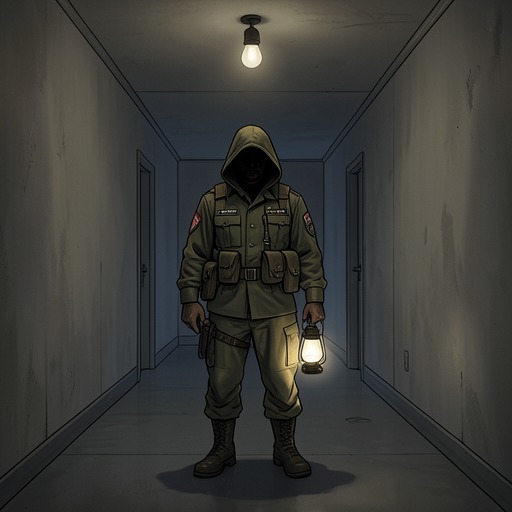
William Chester Minor’s long-term confinement at Broadmoor
The Surgeon of CrowthorneWilliam Chester Minor’s long-term confinement at Broadmoor began after a jury found him legally not guilty of killing George Merrett on the grounds of insanity. The sentence placed him in indefinite custody at the newly built Broadmoor Criminal Lunatic Asylum, where he became Patient Number 742. His confinement joined legal responsibility, psychiatric uncertainty, and a dramatic change in status: a former assistant surgeon and member of a respected New England family was now officially a patient held by the state.
The route from illness to custody
Minor’s confinement followed signs of serious illness that had emerged while he was serving as an army surgeon. During the summer of 1868, he reported severe headaches and vertigo and was sent under escort to be examined. By September, the medical assessment had moved from suspicion to a formal judgment that his mind was failing. Surgeon Hammond described his condition as monomania, then classified him as delusional; the assessment did not specify the subject of the supposed single-minded obsession. By November, the examining doctors considered the condition both suicidal and homicidal and recommended institutional care. These records establish a deterioration before the crime, while leaving its precise origins unexplained.
At the trial, the judge directed the jury to apply the M'Naghten Rules, which concerned criminal responsibility rather than whether the killing had occurred. The relevant question was whether Minor had killed Merrett while under a delusion and was therefore of unsound mind. Late on 6 April 1872, the jury returned its verdict without deliberating. The verdict treated Minor as legally not guilty by reason of insanity, although the account makes clear that he and those around him knew he had committed the murder. The distinction between the act and his legal responsibility determined what followed: the judge imposed the available custodial sentence rather than an ordinary punishment.
An indefinite institutional identity
The judge ordered that Minor be detained in safe custody until the Crown determined otherwise. The Home Department then decided that his detention, given the severity of his illness, would probably occupy the rest of his natural life. His destination was Broadmoor, a new state institution at Crowthorne in Berkshire, set among red-brick blocks behind high walls and spiked fences. He was to be transferred there from temporary confinement in Surrey as soon as arrangements allowed. The account presents Broadmoor both as a purpose-built institution and as a place of penal custody: Minor’s illness shaped the grounds for detention, but the sentence placed him under continuing state control.
The change in designation made that transfer more than a change of address. Before his confinement, Minor was an assistant surgeon in the United States Army and came from an old, well-regarded New England family. In Britain he was formally recorded as Broadmoor Patient Number 742 and classified as a certified criminal lunatic. The number made him legible to the institution through a case identity, while the loss of his former professional title marked the scale of his altered circumstances. The narrative stresses this reversal without suggesting that the legal verdict erased the killing or that his illness made the consequences disappear.
Confinement and changing medical language
When James Murray visited Broadmoor, the superintendent corrected his assumption that the man before him was Minor: Minor was an inmate, had been a patient for more than twenty years, and was the institution’s longest-staying resident. That exchange supplies a later measure of the sentence’s duration. It also reveals how completely confinement had become the defining fact of Minor’s public situation: the dictionary editor had come seeking a valued contributor, but the institution first identified him as a long-term patient.
The medical vocabulary used to understand Minor changed over time. The 1868 description of monomania belonged to an earlier, less settled framework. On 8 November 1918, after Minor was in the United States, his psychiatrist described his condition as dementia praecox of the paranoid form. The later diagnosis identified an illness associated with an early loss of contact with reality, rather than the old category of monomania or the broader label of paranoia. This shift in terminology does not establish a new cause for his illness; it shows how a case once interpreted through Victorian categories was subsequently brought within a developing psychiatric system.
Unresolved causes and consequences
The narrative leaves open whether any single experience caused Minor’s illness. It asks whether the Battle of the Wilderness, the later branding of an Irishman, inherited vulnerability, or the conditions of confinement contributed to its course, but does not present any of these possibilities as proven. It notes that two of Minor’s relations had died by suicide, while expressly acknowledging uncertainty about the circumstances. The evidence therefore supports a history of serious illness and prolonged institutional custody, not a definitive causal explanation.
The account also suggests that Broadmoor may not have helped Minor recover, while framing the possibility that a more compassionate regime could have mitigated his condition as speculation. That qualification matters: confinement is shown as a lasting consequence of the 1872 verdict, but the available evidence does not establish what alternative care would have achieved. The decisive fact is the long interval between the early assessments of 1868 and the superintendent’s report that Minor had already spent more than twenty years at Broadmoor. His case consequently stands at the intersection of changing medical language and a legal system that answered uncertainty about responsibility with indefinite detention.